TOFG INDEPENDENT HOUSING ENTERPRISE CENTER
Build housing.
Build the business behind it.
Practical operating education for founders, housing operators, investors, nonprofits, ministries, and organizations building shared housing with clear economics, defensible systems, and a planned path to scale or exit.
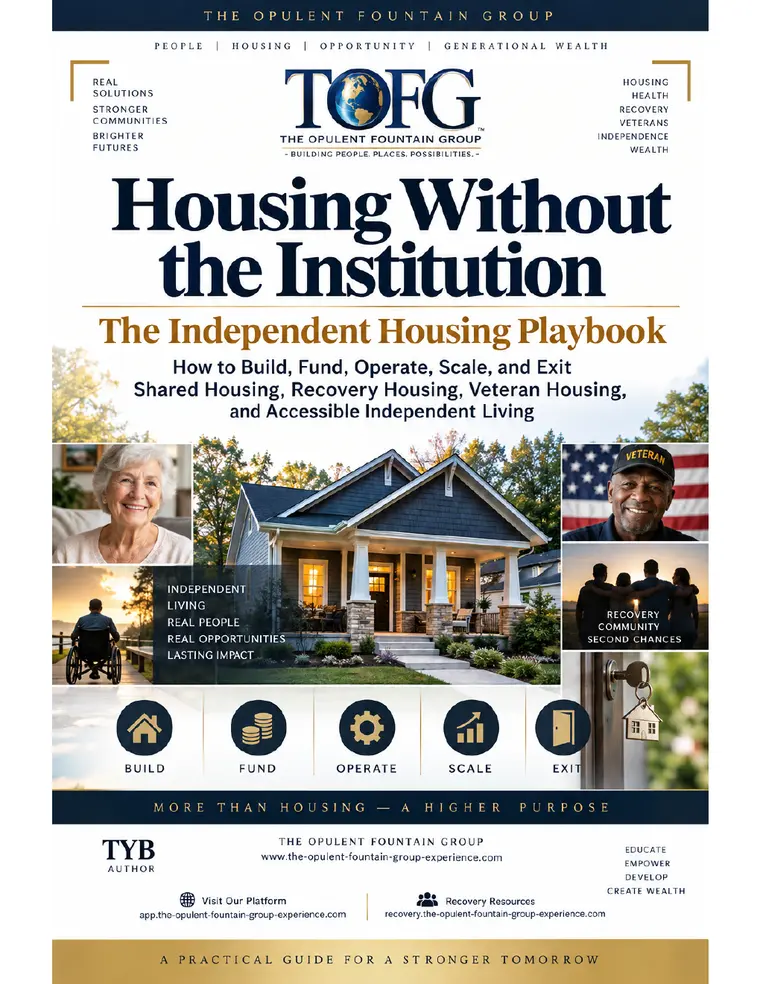
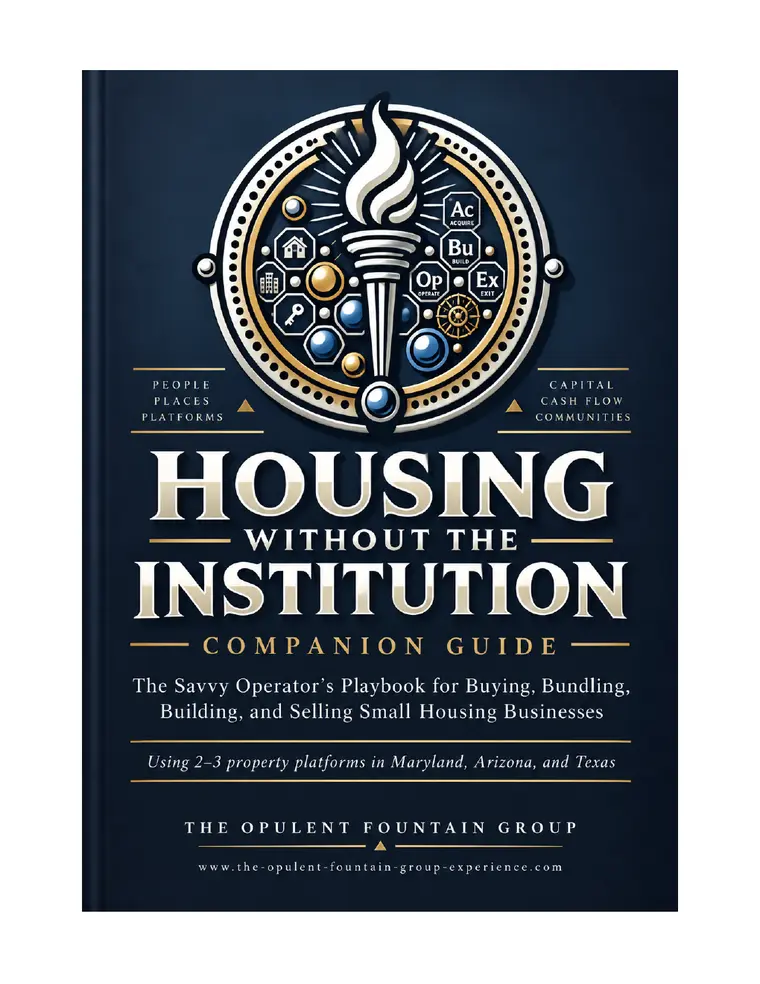 $77 → $147 → $247 → $447 → $795 → custom implementationA deliberate ladder from transaction guide to multi-property operating support.
THE COMPLETE PRODUCT LADDER
Start at the question you need to solve.
The flagship manual remains the full operating system. The companion is the tactical acquisition-and-exit entry point. Bundles add implementation and broader commercial rights.
GO BEYOND THE BOOKS
Bring TOFG into the build.
Customized project roadmap, market analysis, property or deal review, funding strategy, systems architecture, and launch planning.
Request a scoped proposalFor owners acquiring or building multiple houses, integrating two or three assets, preparing a refinance or sale, or installing custom operating systems.
Talk through the platformMarket-specific research, technology, portfolio dashboards, licensing coordination, training, white-label systems, and organizational deployments.
Discuss institutional needsTOFG provides business education, research, systems, administrative coordination, and consulting within the written scope. Legal, tax, securities, clinical, architectural, lending, appraisal, and licensed real-estate work must be handled by appropriately qualified professionals. No income, occupancy, funding, financing, approval, or exit result is guaranteed.
ALREADY HAVE THE HOUSING SYSTEM IN PLACE?
Keep your model. Add the technology, replication system, or growth engine.
TOFG can work from an operator’s existing rules, staffing, housing model, resident journey, referral process, and brand. The engagement starts with what already works and builds the missing infrastructure around it.
01
RESIDENT TECHNOLOGYCustom Resident App
From $7,500 setup$499 monthlyA branded resident and operator system configured around the organization’s existing model.
- Resident onboarding and house orientation
- Check-ins, meetings, chores, curfew, goals, and calendars
- Maintenance, incidents, grievances, and secure documents
- Manager dashboard, roles, notifications, and reporting
- Mobile installation, hosting, updates, and support
Qualifying 10% access priceFrom $6,750 + $449.10/month
Request a technology scope 02
REPLICATION + FRANCHISE READINESSAutomate the Model to Sell or License
From $19,500 setup$1,500 monthlyTurn the founder-dependent operation into a controlled, teachable, measurable system that can support responsible replication.
- Operating-model capture and process mapping
- SOP library, training path, quality controls, and audit system
- Applicant, territory, onboarding, and support workflows
- Multi-location dashboards and brand controls
- Franchise-counsel data room and implementation coordination
Qualifying 10% access priceFrom $17,550 + $1,350/month
Request a replication assessment 03
GROWTH CONSULTATIONFind and Fix the Growth Constraint
$750 diagnostic$2,500 for a 90-day sprint · $1,250/month ongoingFor operators who have housing and systems but need stronger occupancy, economics, referral flow, management capacity, or expansion discipline.
- Financial, occupancy, referral, and operating review
- Bottleneck and opportunity map
- Market, room-pricing, and expansion priorities
- 90-day execution scorecard and accountability cadence
- Optional ongoing Growth Desk support
Qualifying 10% access price$675 diagnostic · $2,250 sprint · $1,125/month
Talk through the growth need 10% Business Access Discount
Request the discount One discount per engagement; categories do not stack. Discount applies to TOFG setup, project, and recurring professional-service fees. It does not apply to books, licenses, taxes, travel, advertising, payment-processing or platform-usage charges, filing fees, or third-party professional costs. Qualification is documented before the final invoice.Available to qualifying active-duty, Guard or Reserve, military-spouse, veteran-owned, minority-owned, baby-boomer-owned, and nonprofit organizations.
Franchise boundary: TOFG can prepare the operational system, technology, training architecture, financial and KPI structure, replication controls, and counsel-ready data room. Offering or selling a franchise may require a Franchise Disclosure Document, contracts, federal disclosures, state registration or filing, financial-performance substantiation, and advice from qualified franchise counsel before any opportunity is marketed or sold.
B2B OPERATOR RESOURCES
Use the books like an operating room.
Each desk below names the decision, the tool, and the pages to open before money or reputation is committed.
Property and acquisition screen
Lawful capacity, demand, deal quality, insurance, repairs, accessibility, reserves, and the finance structure.
Main Manual pp. 75–80 and 110–112State → market → municipality → property
Do not let a favorable state reputation conceal a weak submarket, land-use barrier, or unusable house.
Main Manual pp. 37–40Funding stack and runway
Separate real-estate capital, startup capital, working capital, reserves, and program-specific restrictions.
Main Manual pp. 25–31 and 113–115120-day launch and KPI cadence
Move from validation to control, setup, lease-up, stabilization, and a weekly operating decision cycle.
Main Manual pp. 81–85 and 108–112Two- and three-asset integration
Standardize reporting, policies, referrals, vendors, leadership, working capital, and buyer logic.
Companion Guide pp. 6–14Sell, recapitalize, or keep building
Build transferability and the buyer-ready data room before the transaction becomes urgent.
Companion Guide pp. 15–1812 QUESTIONS SERIOUS OPERATORS ASK
Get an answer. See where the books go deeper.
01Is this only for sober living?
No. The flagship manual separates independent shared housing from recovery housing, veteran and accessible housing, and licensed-care models. It helps an owner choose the lane before choosing the property. See Main Manual pp. 32–49, especially Chapter 3, “Choosing the Right Lane,” and Chapters 5–6.
02Can a first-time founder start without buying a large facility?
Yes. The book examines master leases, lease-options, seller financing, lawful room models, and a shoestring basement operating approach. The point is controlled proof—not pretending capital or compliance risk disappears. See Main Manual pp. 25–31 and 70–80.
03What does the book say about making the room economics work?
It shows how to calculate collected revenue, break-even occupancy, room bands, carrying cost, vacancy, reserves, and revenue per available bed. One worked example uses $3,200 in fixed monthly expense and $950 average collected room revenue, placing break-even between the third and fourth occupied room. See Main Manual pp. 70–74 and 86–90.
04Where can startup money come from?
The capital ladder includes owner capital, seller terms, assumptions, master leases, CDFIs, SBA possibilities, mission capital, donations, sponsored rooms, and mature affordable-housing channels. None is presented as guaranteed funding. See Main Manual Chapter 2, pp. 25–31, and Appendix C, pp. 113–115.
05How do I compare buying, leasing, assuming a loan, or buying subject-to?
The acquisition chapter distinguishes these structures and warns that subject-to does not erase lender due-on-sale rights. It frames title, liens, insurance, lawful capacity, seller terms, repairs, and reserves as one decision. See Main Manual Chapter 12, pp. 75–80.
06Can this help me open within 120 days?
It provides a staged validation, property-control, setup, lease-up, and stabilization sequence with go/no-go gates. Actual timing depends on the property, jurisdiction, financing, and licensing lane. See Main Manual Chapter 13, pp. 81–85, and Appendix A, pp. 108–109.
07How would a house actually find residents without buying questionable leads?
The manual prioritizes institutional trust, a 100-source referral database, vacancy notices, fit screening, follow-up, and source-level conversion and retention tracking. It expressly rejects patient brokering and pay-to-play clinical referrals. See Main Manual Chapter 14, pp. 86–90.
08Why can two or three houses be worth more than three disconnected properties?
A coherent platform can centralize administration, reporting, purchasing, staffing, referral credibility, and buyer diligence. The value comes from integration and transferability—not merely adding beds. See Companion Guide Chapter 1, pp. 6–7.
09What might a real 2–3 property money-making scenario look like?
The companion compares illustrative Maryland, Arizona, and Texas assets and three bundle structures: a Maryland credibility bundle, an Arizona value-add bundle, and a Texas cash-flow bundle. These are strategic examples, not current offers or promised returns. See Companion Guide Chapter 2, pp. 8–10.
10Where is the money made in a bundled acquisition?
The companion’s thesis is that value is created through disciplined underwriting and integration: clean books, stabilized occupancy, common policies, consolidated reporting, sufficient working capital, and a credible platform story. See Companion Guide Chapter 3, pp. 11–12, and Rapid Diligence Screen, p. 17.
11How do I make the company attractive to a buyer or lender?
Build transferable systems, dependable management, consistent financial packages, documented regulatory status, clean contracts, diversified referrals, and an organized data room before you need a transaction. See Companion Guide Chapter 4, pp. 13–14, and Buyer-Ready Data Room Checklist, p. 18.
12Does the system only work if I sell?
No. The companion lays out three paths: sell, recapitalize, or keep building. The manuals also distinguish the real-estate exit from the operating-company exit. See Companion Guide Chapter 5, pp. 15–16, and Main Manual Chapter 18, pp. 104–107.
HOUSING WITHOUT THE INSTITUTION · B2B JOURNAL
Field notes for building the platform.
Short strategic reads drawn from the questions that cost owners the most when answered too late.
The four-room break-even conversation
Why collected revenue—not advertised rent—should drive the first-house model.
Read field note
Start with unavoidable monthly expense, add a real vacancy and collections assumption, then divide by the average amount actually collected per lawful room. Price premiums should follow real room differences such as privacy, bath access, storage, and accessibility—not wishful thinking.
Assumable is not subject-to
Two phrases that can produce radically different lender, title, and insurance outcomes.
Read field note
A formal assumption generally requires lender or servicer approval under the applicable program. A subject-to purchase generally leaves existing debt in the seller’s name and can carry due-on-sale risk. Both require qualified review and complete disclosure.
A bundle needs an operating thesis
Three buildings do not automatically become one valuable company.
Read field note
The assets should share a sensible geography, resident market, compliance lane, referral system, staffing logic, reporting standard, or buyer story. If the owner cannot explain why the assets belong together, the future buyer may not pay for the supposed platform.
Build the data room before the exit
Good exit habits are also good operating habits.
Read field note
Keep entity records, property obligations, insurance, inspections, financial statements, occupancy history, policies, vendor arrangements, and management reporting organized from the beginning. A clean data room can support refinancing and partnership decisions long before a sale.
One hundred sources before paid ads
Housing demand becomes useful when the right organizations trust the fit.
Read field note
Map the actual people who make housing referrals across veteran, reentry, recovery, disability, faith, workforce, and community systems. Track introductions, approvals, move-ins, retention, and friction—without paying per resident or clinical referral.
Housing is not treatment
The safest business model tells the truth about what the operator does and does not provide.
Read field note
Independent housing can coordinate with outside clinicians, telemedicine providers, and community supports without pretending the landlord is the provider. Services, staffing, marketing, and actual practice—not labels alone—determine when a project may enter a licensed lane.
ADDITIVE MARKETING PROGRAM
Turn recognition into ethical reach.
The Recovery Month campaign stays intact. The new command center adds personal, family, and housing-operator feeds; outlet-specific tracked links; partner distribution; reusable commentary; and privacy-safe measurement.
READY TO MOVE FROM IDEA TO UNDERWRITING?